
VPS vs Dedicated: Which Do You Actually Need?
A straight comparison of VPS and dedicated servers, with the real questions that should decide which one you buy.
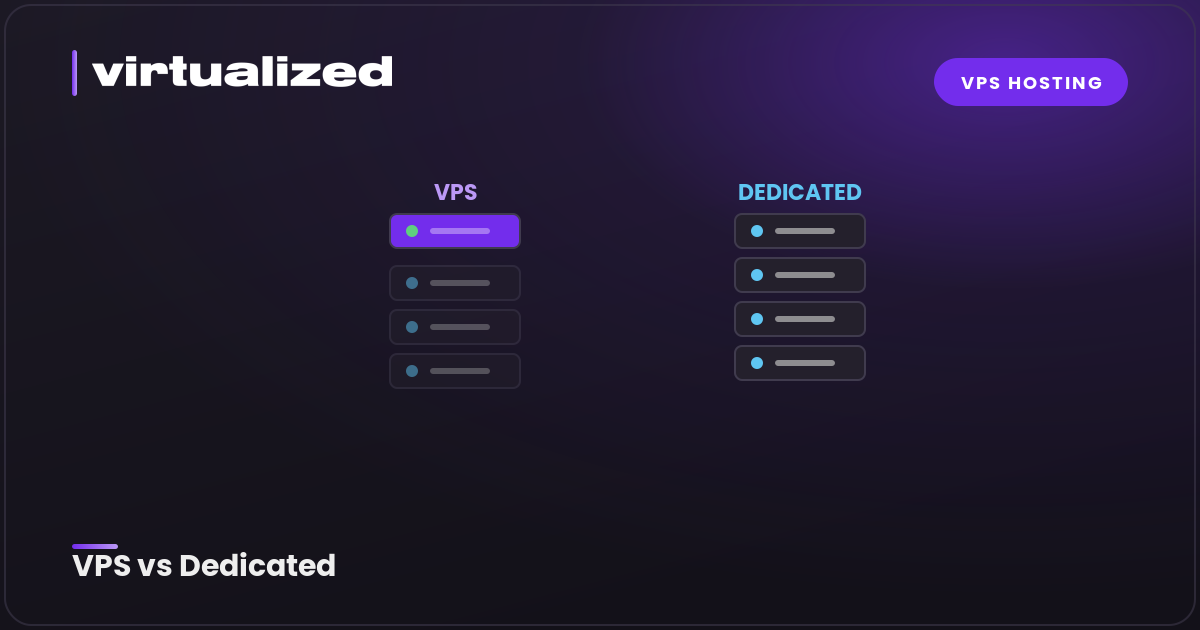
People tend to overthink this one. They read that dedicated servers are "more powerful" and assume that means better, then pay for hardware they will never come close to using. Most projects do not need a dedicated server. Some absolutely do. Here is how to tell which camp you are in.
What the two things actually are
A VPS is a slice of a bigger physical machine. The machine is split into several virtual servers, each with its own CPU cores, RAM, and storage, isolated from the others. You get root access and it behaves like your own server, because for all practical purposes it is. You are just sharing the physical box with other tenants who cannot see or touch your slice.
A dedicated server is the whole physical machine. Every core, every gigabyte of RAM, the entire disk, all yours. Nobody else is on it.
That is the core difference. Everything else follows from it.
When a VPS is the right call
For the large majority of use cases, a VPS is what you want. Websites, web apps, most game servers, development environments, bots, small databases, staging setups. If your workload fits inside the resources of a VPS plan, you gain very little by paying for a full physical machine, and you lose the flexibility that makes a VPS nice to live with.
The practical advantages of a VPS:
- It is cheaper, often by a wide margin
- You can resize it as you grow, usually without a rebuild
- It deploys in about a minute instead of waiting for hardware to be provisioned
- Snapshots and reinstalls are quick and painless
If you are not sure, this is your answer. Start on a VPS.
When you genuinely need dedicated
There are real reasons to step up, and they are worth knowing so you can recognize them when they apply to you.
You need consistent, maximum performance with no neighbors. On a well run host this is rarely an issue, but if you are doing something extremely performance sensitive and want to guarantee that nothing else on the box can ever affect you, a dedicated machine removes that variable entirely.
You need a lot of raw resources. Some workloads simply want more cores or RAM than a VPS plan offers. Large databases, heavy data processing, big game server networks running many instances. At a certain scale, renting the whole machine is both simpler and better value than stacking up enormous VPS plans.
You need specific hardware. Particular CPUs, specialized storage layouts, GPUs, that sort of thing. A dedicated server gives you the actual physical hardware to spec.
You have compliance or isolation requirements. Some businesses are required to keep their workload on physically separate hardware. If that is you, you already know.
The cost angle
A VPS wins on price for what most people do, and it wins on flexibility because you can scale it in steps. A dedicated server costs more up front but can be better value once your needs are large enough that you would otherwise be buying a stack of big VPS plans anyway. The crossover point is different for everyone, which is the honest reason there is no single right answer.
A simple way to decide
Ask yourself two questions. Does my workload fit comfortably inside a VPS plan today, with a bit of room to grow? And is there anything forcing me onto separate physical hardware, like a hard resource ceiling or a compliance rule?
If your workload fits and nothing is forcing your hand, get a VPS. Resize it as you grow. The day you outgrow the largest plan that makes sense, or you hit one of the dedicated-only reasons above, move up. There is no prize for buying a bigger machine than you need on day one.
We run both, so whichever way you land you are covered, and moving between them later is a conversation rather than a headache. If you want a hand sizing it, the specs on our VPS and dedicated server pages lay out exactly what each tier includes.