
How DDoS Protection Actually Works
What a DDoS attack is, how mitigation stops it, and why it has to happen at the network level rather than on your server.
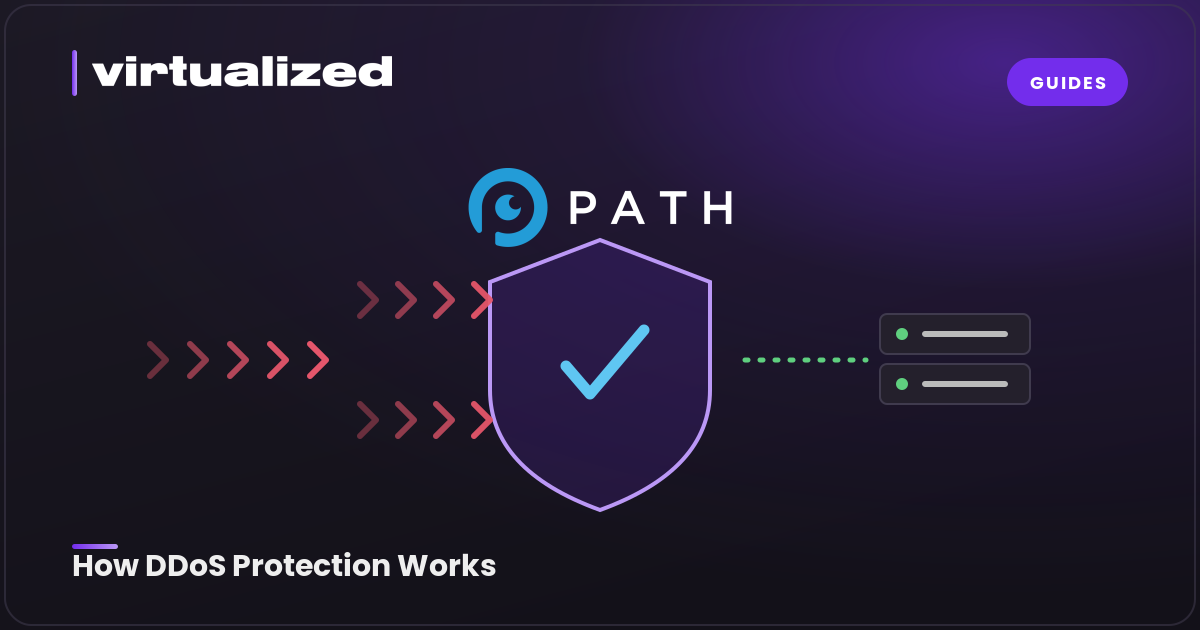
Most people have heard of DDoS attacks without ever being told what actually happens during one, or how protection stops it. It is not magic and it is not complicated once you see the shape of the problem. Here is the plain explanation.
What a DDoS attack is
DDoS stands for Distributed Denial of Service. Break that apart and it tells you the whole story.
Denial of Service is the goal. The attacker wants to make your service unavailable, to knock your website or game server offline so real people cannot reach it.
Distributed is the method. Instead of one computer doing the attacking, the traffic comes from a huge number of machines at once, often thousands of them, spread all over the world. Many are compromised devices whose owners have no idea they are taking part.
Put together, a DDoS attack is a flood. The attacker points an enormous volume of junk traffic at your server from many sources at the same time, trying to use up your bandwidth or overwhelm the machine so it has nothing left for legitimate users.
Why you cannot just block it yourself
The instinct is to think you can block the bad traffic on your server. The problem is that by the time the traffic reaches your server, the damage is already done. Your connection has a limit, and a large attack can saturate that pipe before your server even gets a chance to decide what to drop. It is like trying to stop a flood by closing your front door. The water is already at the house.
This is why DDoS protection cannot live on your server. It has to happen earlier, out on the network, before the flood ever arrives at your door.
How mitigation works
DDoS mitigation sits between the internet and your server, at the network edge, where there is enough capacity to absorb a flood. All of your traffic flows through this layer first. Its job is to separate the bad from the good in real time.
The core idea is called scrubbing. The mitigation system inspects incoming traffic and sorts it. Traffic that looks like part of an attack gets dropped. Traffic that looks like a real visitor gets passed through to your server, clean. Your server only ever sees the legitimate requests, because everything else was filtered out upstream where there was room to handle it.
Good mitigation does this automatically and continuously. The moment an attack starts, the system reacts on its own, without anyone needing to flip a switch, so the flood is being absorbed within seconds rather than after someone notices the site is down.
Why capacity and location matter
Two things make mitigation effective.
The first is raw capacity. To absorb a large flood, the protection network has to have far more bandwidth available than the attack is throwing at it. This is why serious mitigation runs across big, well connected infrastructure rather than a single box.
The second is location. The closer the filtering happens to where the attack traffic originates, the faster and cleaner it is handled. Mitigation spread across many locations around the world can catch attack traffic near its source, which keeps performance steady for your real users even while an attack is in progress.
When the flood gets smarter: Layer 7 attacks
Everything so far describes the classic DDoS, a raw flood of traffic trying to drown your connection. Those are volumetric attacks, and they hit the lower levels of the network, often called Layer 3 and Layer 4. They are loud and obvious, and the way you beat them is by having far more capacity than the attacker can throw at you.
Layer 7 attacks are quieter and a lot more cunning. Layer 7 is the application layer, the part where your actual website or game logic lives. Instead of flooding your pipe with junk, a Layer 7 attack sends requests that look almost exactly like real users. It loads pages over and over, hammers a login form, repeatedly hits the most expensive thing your app can do, or buries a game server in connection attempts. Each request on its own looks perfectly legitimate. The damage comes from the sheer number of them, all aimed at the work your server has to do to answer.
That is what makes them hard to stop. You cannot simply measure traffic volume and drop the excess, because the requests are not obviously junk. Stopping a Layer 7 attack means understanding the application well enough to tell a real player or visitor apart from a bot imitating one, then filtering out the imitations while letting genuine users straight through. That is a harder job than soaking up a raw flood, and it is exactly where weaker protection tends to fall apart.
DDoS protection is not the same as server security
This is worth being clear about, because the two get mixed up. Securing your server, using SSH keys, a firewall, and keeping software patched, protects you from someone breaking in. DDoS protection is a completely separate problem. It is about someone flooding your connection, not getting into your machine. You need both, and they are handled in different places. Server hardening is on the box. DDoS mitigation is on the network.
What this means for you
If you run anything that people depend on being online, a website that earns money, a game server with a community, an app with users, DDoS protection is not optional. Attacks are cheap to launch and common, and a single one can take an unprotected service down for hours.
The good news is that when it is built into your hosting, you do not have to think about any of this. Every VPS and server we run sits behind Path.net filtering at no extra cost, and that protection covers the whole stack, from the raw volumetric floods at Layers 3 and 4 right up to the sneaky application-layer attacks at Layer 7. Path keeps dedicated, tuned filtering for most major games and applications, so your traffic is understood properly rather than bluntly rate limited. The real players and users get through, the attack gets dropped, and the whole thing becomes something you notice as a spike on a graph afterward rather than an outage you had to live through.